The 5th International Conference on Modelling, Computation, and Optimization in Information Systems and Management Sciences (MCO 2025) was successfully held at the University of Lorraine, gathering researchers, experts, and innovators across academia and industry. Organized by the Laboratoire de Conception, Optimisation et Modélisation des Systèmes (LCOMS) in collaboration with INSA Rouen, MCO 2025 served as a global platform for interdisciplinary dialogue in mathematical modeling and intelligent systems.
A significant highlight of the conference was the celebration of 40 years of DC (Difference of Convex functions) programming and the DC Algorithm (DCA). Developed by Prof. Hoai An Le Thi, DC programming has become a cornerstone of modern optimization. A special session, organized in her honor, reflected on the mathematical foundations and wide-reaching applications of this method in areas such as machine learning, engineering design, and data science.
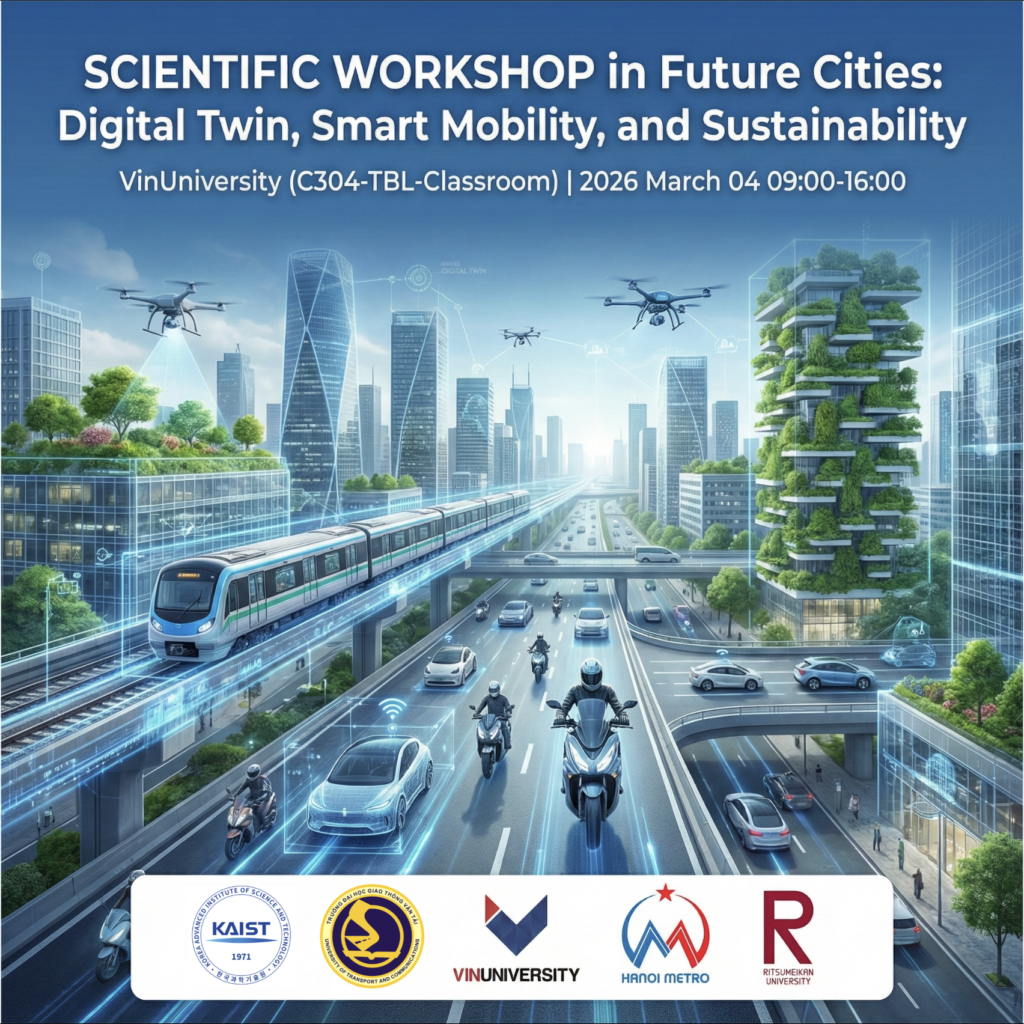
One of the most impactful sessions at MCO 2025 was “Modeling and Optimization in Transportation, Charging, and Logistics,” which spotlighted the interplay between mobility, energy, and digital infrastructure. Co-chaired by Prof. Hoai An Le Thi, Prof. Le Ngoc Tho, and Dr. Dang Quang Khang, this session welcomed contributions focused on smart mobility and low-carbon transitions.
Key research topics included:
- Intelligent transportation systems and urban traffic optimization
- Smart charging infrastructures for electric vehicles and electric buses
- Green logistics and last-mile delivery optimization
- Digital Twins and simulation platforms for predictive transport modeling
- Public transportation planning, dynamic routing, and energy-aware logistics
- Agent-based modeling for demand-response systems and traffic control
- Mathematical models and heuristic/metaheuristic optimization techniques
The session emphasized not only theoretical advances but also practical solutions for sustainable urban mobility and resilient logistics networks, crucial for addressing contemporary challenges like climate change and urbanization.
MCO 2025 hosted several other groundbreaking sessions, including:
- Explainability and Fairness in AI
- AI Innovations in Healthcare (IHAIA)
- Uncertainty Quantification in Supply Chains
- Metaheuristics for Deep Learning Optimization
These sessions demonstrated how advanced computational methods can be deployed across domains, from medical diagnostics to industrial optimization and ethical AI development.
Accepted and peer-reviewed contributions from MCO 2025 will be published in Springer’s Lecture Notes in Networks and Systems, ensuring global reach and academic visibility. Looking forward, the organizing committee announced early plans for MCO 2027, continuing the tradition of excellence in computational modeling and interdisciplinary problem-solving.
For more details and proceedings, visit the official website: https://mco2025.event.univ-lorraine.fr.